
Interpretive Signs in the Park
Along the Hillside trails, nine colorful interpretive signs offer information and inspiration to Park visitors. The signs were created as part of a larger Hillside Improvements Project and were installed in 2020.
Tides

Tides occur as sea levels rise and fall in rhythmic patterns caused by the combined effects of the gravitational pull of the moon and sun and the rotation of the Earth. View this sign ›
Master Plan Mission Statement

“Create a park where people can enjoy San Diego’s natural coastal environment as it once was, free from the effects of man and intended to inspire the user to reflect on the grandeur of the sea, and the beauty of the cliffs that are Point Loma.” View this sign ›
Coastal Sage Scrub Habitat

Low-growing aromatic plants thrive in the Park. Over 80 species of native plants live in the semi-arid coastal climate of Point Loma. Different species have different adaptations to survive with little water. View this sign ›
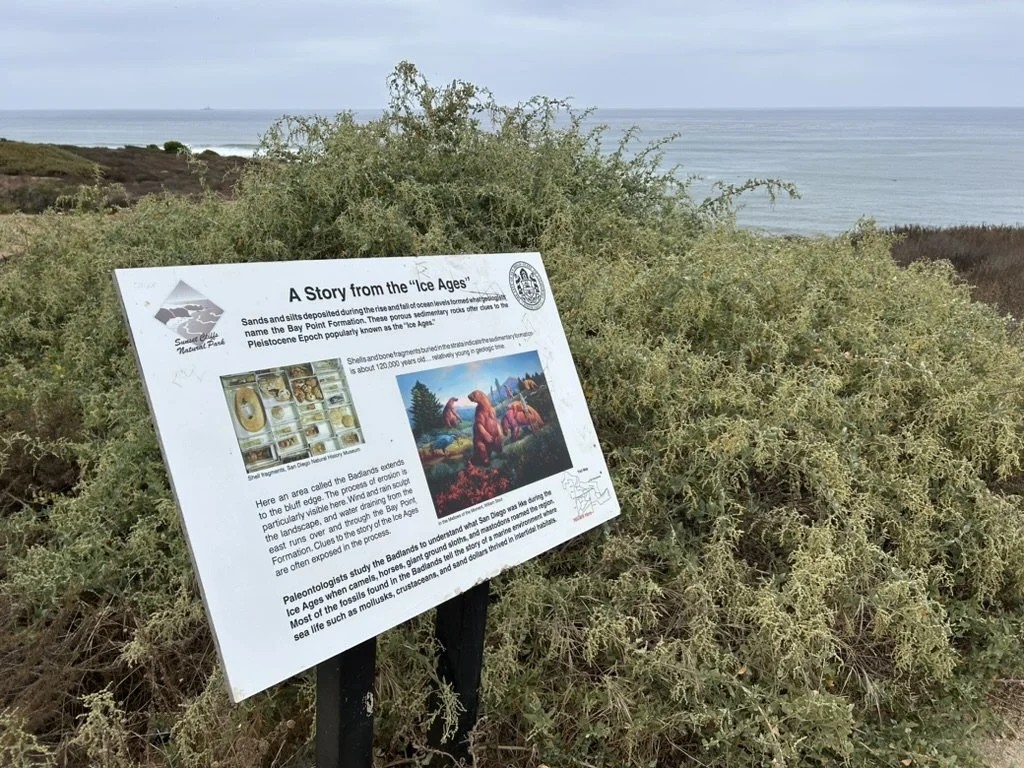
A Story from the “Ice Ages”

Sands and silts deposited during the rise and fall of ocean levels formed what geologists name the Bay Point Formation. These porous sedimentary rocks offer clues to the Pleistocene Epoch popularly known as the “Ice Ages.” View this sign ›
Geology: A Story in Time

The sea cliff tells a story. Two geologic formations are visible. The upper Bay Point Formation, lighter and sandy in color, consists of 120,000-year-old Pleistocene sandstones. View this sign ›
Paleontology: Clues to the Age of Dinosaurs

Imagine a 30-foot-long marine reptile, the Mosasaur, swimming in the ocean and giant ammonites propelling themselves through the water. View this sign ›
The Kumeyaay

According to oral tradition, the Kumeyaay have been here from the “beginning of time,” living on the coast, mountains, and desert according to the rhythm of the seasons. View this sign ›
Migrations

From this location some of the greatest migrations on earth can be viewed. View this sign ›
Birds and Animals in the Wildlife Corridor

The Hillside section of Sunset Cliffs Natural Park has been designated a Multiple Habitat Preservation Area (MHPA). View this sign ›